Wednesday, December 29, 2010

The secret to Cams success

The secret to Cams success is partly his green manuring and good use of legumes and livestock but also his compost operation. The star running the show is Blair a young lady with a bright future. Blair has been working with Cam since march and Cam sent her on the YLAD compost course whcih Blair has absorbed and run with. They use a mixture of free waste products such as horse, poultry and cattle manure mixed with straw and hay bales with innoculum to produce good quality biologically active compost. Blair explained to me the fine line between turning too much and not enough, demonstrated how the readings of moisture, Carbon Dioxide and temperature were taken and decisions on the heaps made accordingly. The heaps are covered with a special green tarp which is breathable and blocks the UV rays. The turning is slow and the tarps very heavy, add the heat and it's quite a tough job. - Don't think our HSE would think too much to it!The turning offers the opportunity to add water and possibly liquid trace elements.
A cyclone is forcast here in a few days so everyone is flat out trying to get on the land to deal with the ruined chickpea crop, plant soybeans, fertilise and where neccessary spray and combine still.

A very big school day

Today Cam introduced me to John, a neighbouring farmer and 1999 Nuffield whose aim is to cut down on the amount of 'stuff coming in through the gate' to maximise his profitability, reduce his exposure to the unpredictable weather and to complete his succession plan. John is in the process of reverting much of his 10,000 acres into grass and leguminous pastures that can eventually be recolonised by native grasses and legumes. John uses a mixture of chicory, clover, fescues and lucerne to give the soil biology and nutrient base a natural kick start and then manages his stocking with an impressively simple but comprehensive grazing system to utilise the grassland. HE runs both cattle and sheep but needs more of both - prices to buy in are hampering progress but a hell for leather breeding programme is trying to address this. John is not organic, he still drenches the sheep etc he just uses as little as possible - the pastures certainly don't recieve any extras and through good choice of species and careful balance of rates the pastures only need the livestock to mnage them.
John runs Dorper sheep as these will lamb every 6 months for him, so although there price at market may be a little lower - although this is changing, yield is king. John had to review his farm or sell it - the old cropping system during the drought just didn't pay. Since the U turn John has been able to pay off the old farm debts, his parents and his sisters. His farm also had literally thousands of tonnes of feedstock in reserve compared to his neighbours paddocks and even after the severe rainfall the area has seen, very little run off and soil erosion from Johns farm.

I have now smelt a lot of soil around the world and it is a full proof method of assessing soil health and microbial activity and for sure Cam has the best condition and smelling arable soils I have ever seen topped only by Johns soils - a truely lovely yummy sweet smell. The only additions John gives his pastures are two biodynamic preparations flown on one in Winter, one in Summer. -Jury's still out for me.


My reading has led me to believe I need a Brix meter - to measure plant sugars so today John and Cam demonstrated it to me - it seems a really good agronomists tool to monitor the crop to help decide when leaf tissues should be carried out.

Today was a very big school day.

Christmas finally came!

Caroline Stocks (also Nuffield orphan stranded in Sydney for xmas) and I had a make shift Christmas on Bondi Beach where we were surprised by the lack of Christmas. So here we are with our Christmas breakfast and having a coffee with Rudloph, Santa, Christmas pud and a Christmas tree - what more could we want. We also added to the festivities with Champagne, strawberries, smoked salmon, mince pies and panetonne but without decorations and carols and a Christmas dinner (which we couldn't believe no one was supplying) it didn't feel like Christmas!

Christmas did however finally come this week courtesy of Rocky McKellar - not only have I been feasting on all the lovely Christmas left overs such as cold ham and turkey, Christmas pud and 'hard sauce' - brandy butter etc but Rocky cooked me Roast Lamb with roasties, crackers, the lot! How lucky am I?


Tuesday, December 28, 2010

1 part conventional, 2 parts biological and a dash of biodynamics

Today I arrived at the wonderfully warm home of Cam and Rocky McKellar's - a suggestion by a fellow Nuffield Lindsay Hargreaves, and what a great one. Cam and Rocky farm in New South Wales, cropping corn, chickpeas, wheat, sunflowers and cattle. Cam and Rocky also have a large farm scale compost operation. Cam uses a mixture of 'conventional', biological and is now experimenting with biodynamic farming methods.

Cam makes good use of the cattle to strip graze forages and stubbles as part of the weed attack, cultivation and nutrient cycling.


Cam adds some bulky solid nutrients such as lime into the compost which is spread at around 3t/ha with a conventional muck spreader. Cam makes his own liquid nutrient blend to apply through a sprayer +/- any pesticides as necessary as the crop requires it. Based on leaf tissue analysis and brix meter readings.

They're also using kelp and zinc treated seed for an initial crop boost and fulvic and humic acids in with roundup and fertiliser application. Organic matters have been rising and soil life building whilst inorganic inputs have been diminishing.

Cam also showed me the old wool shed and shearers accomodation - unused for around 20 years, it was really interesting to see some of the areas farming history still alive on farm.


Tuesday, December 21, 2010

Culture and Cartoons

Due to flight scheduling I have been in Rio for the last few days adn have taken the opportunity to read some more soil books on the Copacabana and Ipanema beaches in the morning and begin writing my report when the sun gets too hot in the afternoon. It also gets very humid here which makes things a bit uncomfortable - orchids happily grow on trees here it's so hot and humid. Anyway, we had Lukes last day covering the cultural scene. Lapa steps Christ the Redeemer statue, and Sugar Loaf Mountain.

The Lapa Steps were created by an artist who couldn't sell his work because he lived in a dangerous part of town. He decided to create something to bring tourists to the area to buy his work. He started to tile the steps outside his studio and has been at it ever since. There are tiles from all over the world. There are even tiles with the beetles, a red telephone box and the simpsons on.

Christ the Redeemer was just as you'd imagine, a big statue on the top of a very hot rock. He has the best views of the city from the top of his mountain and it's a very steep journey up to him. He was built by the church to show any visitors they are a Catholic country, which many Brazilians dispute as they are a very cultural melting pot.

Sugar Loaf Mountain is not the biggest mountain in the Rio bay by any means but the cable car project was always planned for this one - Christ didn't bag his hill 'till much later, but any way, it's a two cable car hop and was the third cable car in the world. It has been running since 1912 and the mayor only finally granted planning permission on the premise that it would only count if the project was going in 100 years time! An impressive feet of engineering - the first mountain can be hiked up but the second, the true sugar loaf has to be climbed, it's faces are incredibly steep and not a single man (was recorded) to have died on this project.

So off now to Australia...

Tuesday, December 14, 2010

A crash by any other name just ain't the same!

Heading up through Paraguay towards Filadelphia and the Mennonite farming colonies the road threats have changed a little, no longer just pots holes, great chunks of road missing and cows not teathered by the road, lose along side / in the road - all made for a pretty interesting 450kms - which only started after a girl ran into the back of our hire Mitsubishi 4x4 in here Suzuki Swift. It's strange having a car accident in a hire car with all the drama being acted out in another language - you don't really feel part of it!

The Mennonites are a peaceful religious group from all over the world. Those that settled in the 'Chaco' (northern Paraguay, known as the thorny dessert) were largely from Canada and Germany hoping to escape conscription and compulsory service in the 1970's they were offered the chance to colonize a new promised farmland to protect the area from Bolivian invaision. In return they were aloud to set up their own communities and laws (still today they don't have to pay taxes). Obviously the first settlers had to build an awful lot, from houses to farm machinery to railroads -largely out of planks of wood - saw anyone?


The area is hot, windy and dry. Rains do come but unpredictably and bush fires and frequent. The soil is sandy which compounds the problems further, however the mennonites have been determined to succeed and in 40 years have established prosperous towns and businesses, large dairy co-ops and grow a mirriad of crops and raise a range of animals including dairy & beef cattle, goats and pigs. The crops are largely grass for grazing and forage, soyabeans, cotton, cassava and some maize / sorghum -as a visiting agronomist it amazed me they could grow anything and all without irrigation.

Wind and water erosion are big problems, shelter belts of trees have been and still are being planted to help alleviate the issue, however the evidence suggests they're only contributing a small amount. On the other hand their is no topsoil to blow away as there never has been any!

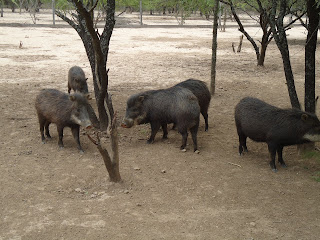
On the way home we stopped in at the Pecurray pig rehab project - the sound these guys make with their jaws is like hearing a man trap snap shut - scarry stuff - they handle them with a small scale cattle coural system. can't balme them either!

And purely for your entertainment - a sign from a toilet door at the Mennonite museum!

Saturday, December 11, 2010

Gears 2, 4 and window glass need not apply

Today was a simple task: travel on abus from Puerto Iguazu to Asuncion. We got to the bus station with plenty of time, let them know we were there and enquired 'will the bus wait for us to get our passports stamped?' A strange look came over the tellers face -'hold on', rapid phonecall in frantic spanish = 'a car will come and get you, the border is very busy today and the bus will not wait'. OK. The car came, we got to the Argentine border, que, stamp, continue. Over the bridge, que some more, stamp - brazilian border. Pull up at the Brazilian bus station, driver points at the empty booth for his bus company and disappears.
We ascertain that the booth will be manned from 3pm post siesta, about 45 mins time. 3.15pm (not bad) man with no english appears - I convey the issue and task left to complete, he understands, more frantic spanish phone calls - 'follow me' grab bags, bundle (with him) into a taxi, head to??? -Ah Brazilian exit border. Exit taxi, power walk in 40 degrees with all luggage across the traffic lanes (who don't stop) to the border, stamp = out of brazil. Our friend jumps on a bus, we follow, standing with the huge bags of domestic traffic waiting to be filled with cheap electricals duty free in Paraguay - huge stocking density and virtually not moving for half an hour over the bridge.

Get off the bus, cross back over the steadily moving (still not stopping) traffic lanes laden with bags at high speed to the Paraguay border -strict rule here - Jolly foreigner will wait, all locals will be given priority! Eventually our friend appears and things speed up - stamp = into Paraguay. Back across the road, into moving taxi??? (decided a policy of throwing my bag in and jumping in behind it swiftly followed by Lukes bag and then him was best).


This taxi was unreal -safe to say it would've been scrapped on UK roads back in the late 80's. The area we are now in is crazy - proper South America. This city is billed as the duty free electrical goods capital of south america and is crammed full of taxi bikes, buses, children, rubbish, stalls, beeping horns and smoggy traffic.

We finally get to the bus station and our friend leaves us propped up against boxes of chicken sweating in the sun, bags of sugar and flasks stacked up waiting to be shipped on a bus. He assures us not long and disappears - 'our hope of reaching Asuncion with him' I'm beginning to wonder? But no, a bus arrives and we climb aboard reaching Asuncion just shy of 1.5hrs later than we first thought - not bad considering.

The night was topped off by our taxi ride from the bus station to the hotel - our taxi (well, it's probably quicker tpo mention what it DID have) found gears 1,3 and 5 unnecceassary, equally un necessary are glass in the windows, door handles, window switches, door liners, boot liner, outside door handle, hand brake - two gears and brakes were fine by me by that point - a little glass to keep the street kids out would've been nice but that's probably me being a hoity toity western woman!

So now, goodnight after one of the most taxing journeys I 've ever made.